Cormier changes his mind; appeals QMJHL suspension
 Patrice Cormier has had a change of heart, and all it’s going to cost him is what little credibility he has left.
The Rouyn-Noranda Huskies and Cormier announced yesterday that they would be appealing the Quebec Major Junior Hockey League’s season-long suspension of the 19-year-old forward.
“He could serve up to 48 games, that's too much,” said Huskies coach and general manager Andre Tourigny.
“I respect the decision of the QMJHL even if I find it too severe. I deeply regret the circumstances surrounding this event and I wish Mikael Tam a speedy and full recovery. Thanks for your attention,” said Cormier in a short statement read to the Canadian Press by telephone.
This is a departure from his statement Tuesday morning: “I fully respect the Quebec Major Junior League's decision regarding the Mikael Tam incident.”
Earlier this week I had criticized that particular statement by Cormier because there was no actual apology to Tam. He still hasn’t apologized and this appeal is much worse, adding insult to injury.
Cormier could have continued his career in, as Tourigny said, just 48 games. If he had accepted his punishment, acted contrite whenever asked about the incident and worked hard on the ice to develop as a player, he’d likely make the NHL within two years.
But now he’s rubbing some salt in the wound, and not winning over any supporters.
Although I felt that the suspension was a fair punishment for what was clearly a malicious hit, other corners were calling for a lifetime ban. I can only imagine the ink that will be spilled if Cormier’s suspension is shortened.
That said, I do understand the team’s motivation behind the appeal. Rouyn-Noranda paid a hefty price to acquire Cormier. Specifically, they sent two promising players in Michael Beaudry and Alexandre Mallet (both just 18 years old) as well as three first round draft picks and one second round draft pick to the Rimouski Oceanic for Cormier and Jordan Caron.
To lose one of those players to suspension for the rest of the season – and possibly for the rest of his junior career if he moves on to the NHL or AHL next year – cripples the Huskies playoff chances. Rouyn-Noranda’s playoff window is closing, and Tourigny knows that he gave up the team’s future is bleak without those four picks.
The problem is, of course, that although Cormier might not play again this season, he’ll definitely be playing somewhere next year. The same can’t be said for his victim, Mikael Tam.
Although Cormier’s suspension is a bitter pill to swallow, it did give him the opportunity to move on. The same can’t be said for Tam. Cormier should be counting his blessings, not the number of games he’ll be missing.
Cormier’s suspension should start a discussion about changing hockey’s culture
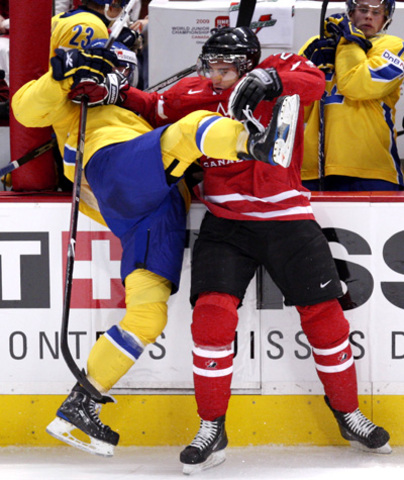
Patrice Cormier, as a member of Canada's world junior team in action with a Swedish player.
The Quebec Major Junior Hockey League has suspended forward Patrice Cormierof the Rouyn-Noranda Huskies for the rest of the regular season and the playoffs.
Of course they did. Really, it’s the only option the league’s disciplinarian had after the former captain of Canada’s World Junior tournament team laid Mikael Tamof the Quebec Remparts out with a vicious elbow.
But there are still lots of questions, the biggest and broadest of which is: where do we go from here? Not just Tam and Cormier, but the game itself.
By all accounts, Tam has already begun to recover. He hasn’t shown any signs of a concussion and he’s been released from the hospital. All good news, to be sure. But no one is sure if he’ll be able to re-join his teammates, or when. Sad when you consider that the 18-year-old defenceman was having a career season with 10 goals and 12 assists.
Cormier, of course, will be spending most of his time training on his own. Lou Lamoriello, the GM of the New Jersey Devils who drafted Cormier 54th overall in the 2008 draft, has already stated that the team will not place him in the American Hockey League or on any other teams affiliated with the Devils.
"We will honour the league's suspension, have not considered, and will not explore other avenues for his return this season," Lamoriello said in a press release.
This won’t be the end of Cormier’s career though. He's still a top-flight prospect who might be able to bounce back from this incident. Certainly, if he keeps his head down, his nose clean and continues to develop as a player, the Devils will have to consider calling him up to the NHL in the next few seasons.
Cormier has issued his own public statement, saying, in part, “I deeply regret the circumstances surrounding this event and wish Mikael Tam a speedy and full recovery."
No apology to Tam, just some best wishes. As so often happens in incidents like this, the injured party has to deal with the consequences of the play, while the offender is able to, eventually, resume their career. I wouldn’t want Cormier on my team, but the world of hockey has found roomin its heart to forgive a lot of players after similarly vicious incidents. Todd Bertuzzi is the first name that comes to mind.
And that brings us to the real problem: violence in hockey.
After all, everyone abhors Cormier’s cheap shot, but no one knows how to remove dirty hits from the game. I know that I enjoy watching a good hockey fight, as I think most people do, and there’s nothing like a good, solid hit. Hockey is an intrinsically violent game.
But there is a semi-permanent, translucent line in hockey that a player can cross where finishing their check somehow becomes a late hit. Standards seem to change case by case. This line needs to be better defined, with clearer consequences outlined. How else can hockey separate good violence from, for lack of a better term, bad violence?
I’m not sure. Hockey and hockey culture will always be physical, and tough players will always be admired. It would require an incredible sea-change to adjust the attitudes of players, coaches, officials and fans.
Suspending Cormier is certainly a good step. He’s a very visible junior hockey player, and as I mentioned in an article last week, he’s a repeat offender. It sends a strong message to the hockey community, and was the natural conclusion to a nasty chapter in QMJHL history.
Forcing Cormier, and other offenders at all levels of hockey, to engage in public awareness campaigns might be productive as well.
However, the most effective solution would be to force the offending player’s team to forfeit the game.
Had Quebec lost that game (the Remparts rallied to win 3-2 in the shootout), I feel that the QMJHL should have ruled the game as a forfeit for Rouyn-Noranda. If this became standard practice in junior and professional hockey leagues, I think it would create a sense of peer pressure that a cheap or dirty hit hurts the team in the standings, and players and coaches would do a better job of policing themselves. After all, no one wants to be directly responsible for costing their team a game, in addition to be suspended and fined.
It will take a huge, systemic change to eliminate dirty hits from hockey, but I think it’s time that better minds than mine began to apply themselves to this problem.
Now this is a Super Bowl match-up!

Pierre Garcon celebrates the Indianapolis Colts 2009 AFC championship while holding a Haitian flag.
Yesterday, the Indianapolis Colts and New Orleans Saints earned their way into the National Football League’s championship, the Super Bowl.
I couldn’t be happier that these two teams are the finalists because this is the Super Bowl as it should be. The best versus the best.
No upsets, no underdogs, no wild card teams and no representatives from a weak division or with a mediocre 8-8 record. For the first time in more than a decade, the top two seeds from each conference will be competing.
The Indianapolis Colts (14-2) will be representing the AFC after winning their first 14 games. Their final two games, well, were a bit controversial. After Indy clinched the top playoff seed in the conference they rested most of their starters so that the Colts would be in top form for the playoffs. Their fans were outraged, but it seems to have paid off. Peyton Manning and Company have looked dominant against the San Diego Chargers and New York Jets.
For their part, the New Orleans Saints (13-3) actually tried to protect their perfect season, but ended up dropping their final three games. Despite that, they still finished with the best record in the NFC and have turned it back on in the playoffs.
This is the first time the Saints have ever been to the Super Bowl, and it’s provided a lift to the city of New Orleans, still recovering from Hurricane Katrina.
This match-up - this is the way sports should be.
Unfortunately, as the media, television in particular, has exerted more control over professional leagues, the level of competition has been watered down. Longer schedules and more playoff games are added to increase advertising revenue, and the fans suffer with bizarre, unlikely match-ups in the postseason.
The NFL is particularly prone to these off-balance games. Its single elimination playoff format leaves too much to chance with fluke plays and coin tosses determining who moves on to the next round.
More often than not the best teams never end up playing each other, to the detriment of the fans.
Simply put, the Colts and the Saints are the cream of the crop and that’s the way the Super Bowl should be. Nothing but the best.
How I fell in love with lacrosse

Bob "Whipper" Watson played a key role in my growth as a lacrosse fan.
I can still remember the exact moment when I fell in love with lacrosse. My godfather had given me tickets to the Toronto Rock as a Christmas present. They were the newest team in the National Lacrosse League, having played in Hamilton the previous season as the Ontario Raiders, and this was their home opener.
I’d heard of lacrosse, but never seen it played. But, hey, it was at Maple Leaf Gardens, a treat by itself. It was easy to persuade my friend Ruben to come along.
As the fourth quarter wound down, Toronto’s goaltender Bob “Whipper” Watson stopped a shot and came out of his crease to pass to a streaking “Speedin’” Stevie Toll. As Watson released the ball, one of the Buffalo Bandits cross-checked him in the back of the head and knocked him out cold.
I seem to remember Toll scoring on the play, but I was distracted by the mayhem that exploded around me.
As players paired off to fight, the crowd chanted “BUFFALO SUCKS”. The offending player got free of his dance partner (possibly after knocking him out as well) and ran around the floor, giving the finger to the crowd. Fans tried to climb over the boards to get at him while the referees and arena security tried to gain control of the situation.
It was the greatest thing I’d ever seen.
Ruben and I didn’t know it at the time, but we were watching the birth of a dynasty. The Rock would win the championship that year, and win another four in the next five years. They’d win their division from the team’s inception in 1999 and every year after that until 2005.
For a championship starved city like Toronto, it was incredible.
Ruben and I didn’t understand half of what was going on in that first game, but sitting in the Reds of Maple Leaf Gardens we decided that we were going to pick up the sport.
We went to more games that season and got a small petition together to start a team at our high school. Unfortunately, the head gym teacher told us that he just didn’t have the staff to coach another team and our dreams were dashed.
In my second year at the University of Toronto I ended up playing a few minutes with the varsity team, but I was much too late to the sport to be any good. The next year I became an assistant coach, and became more and more involved in the administration of the game.
I watched as many games as I could, read magazine and internet articles, played intramurals and gradually began to understand the Xs and Os of lacrosse.
Eventually, I became the Director of Communications for the Canadian University Field Lacrosse Association and interned with the Toronto Nationals, a professional field team that plays in Major League Lacrosse. I’ve been lucky enough to meet greats like Gary Gait, Colin Doyle and Dan Dawson, as well as interview Paul Gait and the legendary Syracuse University coach Roy Simmons Jr.
Even though I'm relatively new to the sport, everyone I've ever met in the lacrosse world has been nothing but kind, friendly, and accommodating. It's the most accessible professional sport that I can think of, with fast action, cheap tickets and athletes that the average fan can relate to. In a crowded sports market like Toronto, there's nothing like the Nationals or Rock.
Although I’ve written about lacrosse extensively and seen a lot of the behind-the-scenes action of pro teams, I’ll always be a fan first. That’s why I’m so glad that I’ve been able to watch all of the Rock’s televised games this winter. Lacrosse has a spot in my heart that no other sport will ever be able to occupy.
Mea culpa: Manchester United is in financial trouble
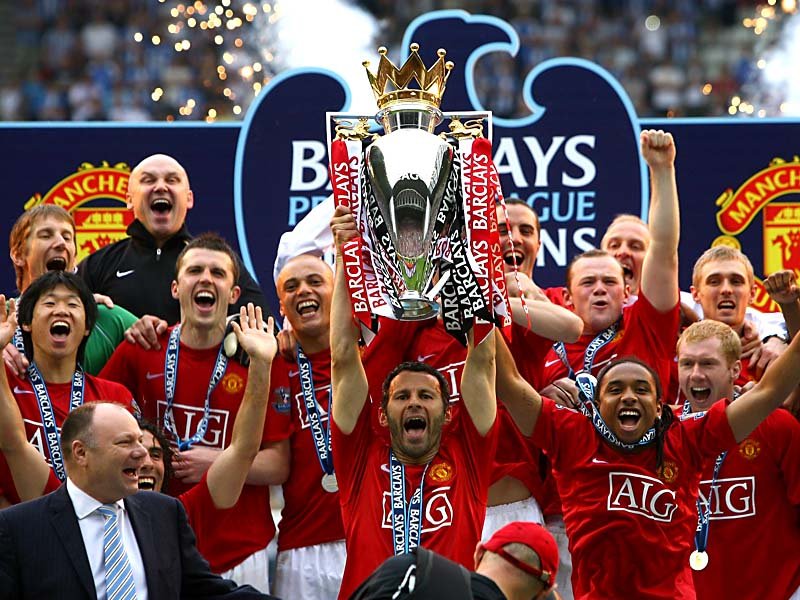 Almost two years ago I wrote on my defunct blogthat European soccer fans should “relax” about foreign ownership like Tom Hicks and George Gillet of Liverpool and the Glazer family of Manchester United.
Yesterday BBC News announced that Manchester United’s debt has now reached £716 million(that’s $1.1 billion USD), with patriarch Malcolm Glazer handing out loans of £1.67 million to each of his children who happen to be directors of the club.
Hey ManU fans? My bad. I was wrong. The Glazers have put your club at risk with their mishandling of team funds. A small piece of good news is that the Red Devils can stay afloat as long as they keep winning, which they are sure to do.
The original uproar surrounding United was sparked by the Glazers’ takeover of the publicly traded franchise, effectively taking it off the market. The closing remark in my original post was: “Thanks to [the European] system of relegation and ranked leagues, for these men to make money, they need to make sure that their teams are constantly competitive.”
I still believe that, but the Glazers’ tenure as owners of Manchester United is definitely putting my theory to the test.
United is still one of the best teams in the English Premier League. They’re currently in third place, one point behind first place Arsenal, and in a position to return to the Champions League. Forward Wayne Rooney is one of the best players in the league, with 14 goals so far this season.
Their merchandise is as popular as ever, with their familiar red and gold logo still gracing jerseys, shirts, hats and all kinds of kit.
So where is all this money going? Running a professional team of Manchester United’s calibre is always a costly enterprise, but to the tune of £716 million?
According to journalist David Conn on the Guardian’s Football Weekly Extra podcast, the Glazers have loaded the club with the debt they had taken on to buy United. That’s right; the team is paying for its own purchase. That original debt, plus interest and the usual litany of fees from banks and lawyers, has eaten away at the club’s value.
It gets worse. Conn says that contrary to manager Sir Alex Ferguson’s claims, the £80 million in transfer fees collected from Real Madrid for Cristiano Ronaldo’s transfer won’t be available for roster acquisitions, as the money has already been paid towards United’s debt.
In their most recent financial report, Manchester fully acknowledges that if they can’t continue their current competitive pace, they are in grave financial trouble.
This reinforces my belief that relegation/promotion and on-field success are still the keys to making money, but there is still cause for concern. The Glazers are making the same mistakes that launched the financial downturn that is still affecting the global economy. Debt to pay off debt is never sound planning. Although the football side of the team can maintain this pace, the business side definitely can not. Things have to change at Old Trafford, and soon.
Fans of Manchester United, and soccer fans as a whole, should be keeping their eyes on this situation. There’s more than just pride at stake on the EPL tables with United needing on-field success to stay afloat financially.
Entrance video for the University of Alaska Fairbanks hockey team
This isn't news, or a feature. It's just a fun video that I saw on Twitter thanks to EugePYDK, better known as Eugene Ahn, the co-host of War Rocket Ajax, the writer of Self-Titled Eponymous, the rapper Adam Warrock, the Fake AP Stylebook and just generally a busy guy.
It's nice to see a hockey video causing so much excitement... and hey, it does so without depicting a vicious elbow to the head.
Enjoy.
Phil Kessel cost the Leafs too much
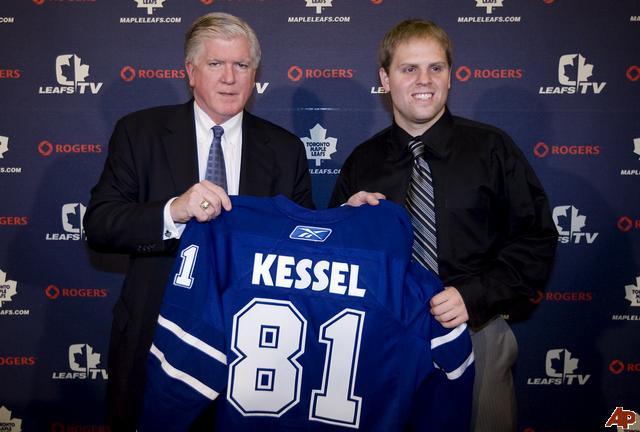 The Toronto Maple Leafs edged the Nashville Predators 4-3 Monday night, getting a late game-winning goal from young Phil Kessel, Brian Burke’s shiny acquisition, the cornerstone of the Age of Truculence.
Since he started playing for the Leafs (about six weeks after the trade that brought him to Toronto from Boston) he has scored 15 goals and 13 assists, and is easily the best player on the Leafs.
But I think the trade has been a terrible mistake. He doesn’t have enough help on the ice, he’s not a franchise player, and ultimately, the price was too high for Toronto.
Don’t get me wrong, he is a great player. He finds open space, sees plays developing and makes intelligent decisions with the puck. He can score from anywhere in the offensive zone and demands that the other team cover him tightly, giving his teammates room to breathe.
Unfortunately, his teammates don’t seem to know what to do with that space. As a result, opposing defences have begun to take advantage of the Leafs lack of depth. They have, as defensive coaches say, begun to cheat on Kessel.
Defensive strategy relies heavily on reactive responses to an offence. Obviously, a good defence reacts to where the puck is, where the players are. But because Toronto does not have a strong secondary scoring threat, defences have taken to sealing off Kessel as soon as he’s on the ice. They know that should he pass the puck, the Leafs probably aren’t going to be able to score.
Now, there are some players who would be able to overcome that, who could make the players around them better. The kind of players that only need to be identified by their surnames: Gretzky, Lemieux, Crosby, Ovechkin, Brodeur, Roy. Unfortunately, Kessel just doesn’t belong there. He’s a very good hockey player, but his shoulders aren’t broad enough to carry an entire franchise.
And that, ultimately, is why trading two first round picks and a second round pick was too much for Kessel.
That’s an awfully high price, jeopardizing the Leafs for the next five or more years. Frankly, I’m not sure that I’d trade that much for any of the franchise players mentioned above, let alone Phil Kessel.
With the Leafs toiling near the bottom of the standings, the trade looks even worse. There’s a good chance that the division rival Boston Bruins landed themselves a top three pick that could mean Taylor Hall or Tyler Seguin, both quality players that would’ve helped the Leafs considerably, and at the rookie maximum salary instead of Kessel’s $27 million over five years.
When there were rumours that Toronto was going to trade with the Boston Bruins, that Burke might land Kessel, a proven sniper, I was ecstatic. At last, the Leafs were going to start to turn it around. Most people I knew thought that too, but my good friend Ruben and my dad both held out, saying that it was a bad trade. It took me a while, but now I see it too. Phil Kessel is a quality player, but the price the Maple Leafs paid was way too high.
The Quebec Major Junior Hockey League is definitely not soft
This video has been making the rounds Monday morning, and it’s pretty tough to watch.
At about the one-minute mark Team Canada’s world junior captain Patrice Cormier comes off the Rouyn-Noranda bench, skates through centre ice and lays out Quebec’s Mikael Tam with a vicious elbow to the head.
Ironically, of the three leagues that comprise the Canadian Hockey League, it’s the Q that has a reputation of a softer, finesse style of play that emphasizes goaltending and skilled scorers. The events of this weekend underscored the fact that this really is not the case.
According to TSN.ca: “Following the hit, Tam was convulsing on the ice before being taken off on a stretcher. Tam suffered trauma to the skull and brain and lost many teeth. He is now in stable condition in hospital and will remain under observation for at least two days.”
Although I followed the results of that game, the summary really didn’t do justice to the viciousness of that hit. After all, "Penalties: ROU - Patrice Cormier (03:32)(maj.), ROU - Patrice Cormier (03:32)(match)" isn't much of a story.
As TSN’s Bob McKenzie tweeted: “This Cormier elbow is sickening on so many levels. I have never been so discouraged about the game of hockey as now.”
The QMJHL’s Disciplinary Prefect, Raymond Bolduc, is currently investigating the incident, and the league will take action in the next day or two. I expect that Cormier is looking at some lengthy time away from the ice.
Watching the Tam video is reminiscent of Cormier’s hit in a preliminary World Junior Championship match against Sweden where he hit Sweden's Anton Rodin with an elbow and bloodied his nose.
I thought Cormier took unnecessary penalties throughout the WJC tournament, and his actions definitely hurt Team Canada’s performance in the playoff rounds.
Also on Sunday, Bolduc suspended Tommy Tremblay of the Shawinigan Cataractes for four games. Bolduc found that Tremblay had been the aggressor in a fight with the Victoriaville Tigers’ Guillaume Goulet.
The left-winger earned two game misconducts during the game, and the league tacked on another two after reviewing videotape of the incident on Saturday. Additionally, the Cataractes were fined $500.
I follow the QMJHL pretty closely, in fact, it’s my favourite junior hockey league. Although it’s not nearly as rough and tumble as the Western Hockey League, I think its physicality is under-rated.
Although line brawls (like the one that happened between the Vancouver Giants and Prince George Cougars Saturday night) are rare in Quebec, the QMJHL has its fair share of truculence.
Former pros should be allowed in varsity sports
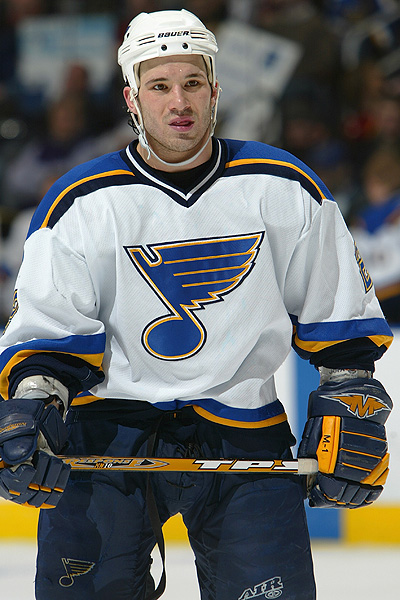
Mike Danton, formerly of the St. Louis Blues, is drawing attention to CIS eligibility rules as he joins the St. Mary's University Huskies starting this Thursday.
The Globe and Mail’s Roy MacGregor wrote an article Tuesday morning about former NHLer Mike Danton joining the St. Mary’s Huskies in which he criticized Canadian Interuniversity Sport for having eligibility loopholes that will allow the former professional to play for a university team.
MacGregor is a fantastic writer, and his heart is in the right place, but I humbly disagree. Having former professional athletes playing varsity sports does no damage to the sport, whatsoever.
For those of you not familiar with Danton’s sad tale, the CBC’s Fifth Estate has a very detailed timeline of his personal and professional life that includes links to interviews and news stories. Further, Hockey Night in Canada’s Elliotte Friedman has an excellent article on his one interaction with Danton and his agent David Frost.
In short, Danton is a 29-year-old former professional hockey player who was convicted of a murder-for-hire plot. Now released from prison, he is enrolling at St. Mary’s in Halifax to complete the degree he started while incarcerated and is going to play hockey in the CIS.
MacGregor is all for giving Danton a second chance at life, but does not think he should be allowed to play hockey with university students.
“The notion of a still-growing high school graduate challenging a mature man with three years of NHL hockey to his credit is simply preposterous,” says MacGregor.
Only, really, it’s not that dangerous. Teenagers and adults can easily play full-contact sports without any risk of injury.
After all, how old was Luke Schenn when he joined the Toronto Maple Leafs last year? What about Steve Yzerman when he became a Detroit Red Wing? Sidney Crosby? Wayne Gretzky joined the World Hockey Association because they let him play before he turned 18.
Although Danton will undoubtedly play some teenagers, most starting players on CIS hockey teams will be in their early-to-mid 20s, just like the NHL.
“As for ‘professionalism,’ the rules are mild – one year of eligibility lost for every year of pro – which still leaves Danton with two years eligibility for university hockey,” says MacGregor.
I have some hands-on experience with eligibility as the former Director of Communications for the Canadian University Field Lacrosse Association, and have dealt with issues like this.
CUFLA is an independent league that has 12 member teams from Ontario and Quebec. The league’s eligibility rules line up those of the CIS, including allowing active professional athletes from the National Lacrosse League to join teams.
What’s the logic? Simple. CUFLA plays field lacrosse, while the NLL is indoor lacrosse. Although many of the skill sets are the same, the field of play is completely different, much of the equipment is different and many of the rules are different.
The pro lacrosse players that end up on these teams act as role models that improve the level of play on the team and often serve as leaders during games and in the locker room.
What kind of effect Danton has on his Huskies teammates is anyone’s guess. Honestly, Danton is not in a position to serve as a positive example to the young players at St. Mary’s, but he could have some useful advice for them or at the very least serve as a cautionary tale.
Danton will probably be one of the best players on his team, if not all of CIS, but that doesn’t mean he should be banned from playing.
His inclusion on the St. Mary’s Huskies is not going to start a flood of NHLers joining collegiate teams. Teams are not going to be able to load their teams with ringers because there are rules that restrict scholarships as well as academic standards that guarantee the purity of the varsity game.
Frankly, today’s professional athletes have so much earning power that there is not much a university or college could offer them except tuition incentives. And really, if you could potentially earn millions per year, is a few thousand a year and mandatory class that exciting? I doubt it.
The only other player to downgrade from the NHL to CIS was Jared Aulin. Ever heard of him? No? That’s because his impact was minimal. University hockey survived that experience just fine, and I am sure that it will continue to thrive with Mike Danton playing a couple of years of hockey.
Archives
- February 2014 (1)
- June 2012 (1)
- January 2012 (1)
- December 2011 (1)
- November 2011 (2)
- June 2011 (3)
- April 2011 (2)
- March 2011 (2)
- February 2011 (5)
- January 2011 (5)
- December 2010 (3)
- November 2010 (11)
- October 2010 (11)
- September 2010 (7)
- August 2010 (10)
- July 2010 (10)
- June 2010 (5)
- May 2010 (14)
- April 2010 (18)
- March 2010 (24)
- February 2010 (22)
- January 2010 (20)
Categories
- Books (18)
- Comics (15)
- Food (2)
- Movies (3)
- Music (2)
- Personal (4)
- Reading (22)
- Site administration (7)
- Sports (143)
- Television (2)
- Video Games (2)
- Writing (23)
